682 points | 2d ago | Discuss on Hacker News | Back to Radar
When it comes down to "Privacy" vs "Profit" they certainly know which side they stand on.
classic HN...
That's different from weakening their e2e stance or building a backdoor which they haven't done.
What they did is no different from what they do in the US, again, they didn't create a backdoor, they already had access to their non-e2e encrypted services' encryption keys.
There is a reason they pulled out of offering ADP in the UK, because it would weaken their privacy and security posture. The reuters link is distinctly not that requirement.
Put differently would Chinese people be more secure with Apple phones (keys stored in China) or Xiaomi phones (keys stored in China)?
Of course a very tiny incentive, but if many companies do it becomes a significant one.
Then you can complain that Big Co doesn’t respect the law?
That's a perfectly viable option that several US companies have taken.
It's very easy to see because if they were meaningful, there's zero chance Apple would still be allowed to operate in China.
non americans, or americans communicating with non americans or americans outside of the US have no privacy from the US government
Two panels showing the same scene. A man, seen from behind, is talking to an older official in glasses, a suit and a tie.
Top panel: The visitor asks: “You give money for yachts to your wives’ and brothers-in-law’s companies?” The official calmly answers: “Yes, so what?”
Bottom panel: The visitor asks: “Aren’t you scared someone will find out?” The official answers: “Well, you just found out. And?”
I think the big part of the problem right now is that we reached the point where those things are no longer even seen as important. Getting caught simply doesn’t cost anything.
It wouldn't be a problem if there were any sort of pretend equality to it.
A datacenter goes up overnight and unopposed all while the same officials are threatening your neighbor to the tune of five figures over a goddamn deck. If the little guy got his shit rubber stamped in the same manner as the big guy the system wouldn't come off looking as bad as it does.
A full 45% of a new the cost of a residential build in Australia is taxes and permits / approval etc.
Meanwhile, across town, a large data centre was approved well after the acquaintance submitted their initial application, and when I last checked the structural steel was going up before the excavation had commenced on the residential block.
The cost of developing land is really a testament to the cumulative drag that can be built up by useful idiots and commercial interests putting in their $.02 year after year after year.
In a neoliberal order, you can't be assigned moral shame for doing things that are monetarily beneficial. Any kind of resource accumulation is being smart, hustling, etc. Old moral virtues have little weight or consequence there.
Like almost all modern farmers, he is using high tech tools to alone do the job of 5-10 people.
https://demotywatory.pl/5100725/Zwyczajny-dzien-w-polskiej-p...
A small child says to the father: “Dad, I’m thinking of getting in to organised crime.”
To which the father, looking over the newspaper, says to the child: “Private or public sector?”
I don't agree at all with the thesis, and surely there could be after the fact revelation/foi requests made possible, but govts don't like to cede power to their citizens in general.
If it was for an active investigation, one would think it would be targeted to those under investigation.
I deliberately wrote "less easy" as opposed to "impossible", because authorities love to pretend it's completely impossible to do an investigation without persistent remote root access to everybody's devices, when that is obviously not true.
There are 1000x more ways to catch criminals nowadays than ever before in history, even without scanning innocent people's devices.
But that means it would take some work and is harder to automate.
In my opinion, in a free society, that would be a good thing.
What are you not agreeing with?
But if your data is accessed and you turn out not to be guilty, you should not only receive specific notification after a fixed period of time (can be years) but significant compensation. I would start at $20k type amount. This would naturally calibrate it to limit how much they use it while preserving the capability for when it is really need it.
The question is whether making law enforcement easier is worth the sacrifice of everyone's privacy. The optimal amount of crime is not zero.
I don't agree with the policy either, but come on. After the fact discussion causes exactly the same notional harm as contemporaneous discussion: people learn what you're doing, and move their records somewhere safer.
If we discussed why the court found some person guilty, then people would just avoid breaking the law.
We want people to avoid breaking the law. That is the goal of the law. We don't want people to avoid getting caught breaking the law.
We can debate whether blame should be assigned to the government for doing this in secret or to Apple for overselling encryption and creating a situation where complying with these orders threatens their business. We can also debate whether or not the government should care about the business impact of these orders.
Apple is not overselling encryption. They are selling functional encryption, as opposed to broken backdoored things pretending to be functional. Governments trying to introduce backdoors should find themselves assaulted and harried at every opportunity.
The concept of a "Technical Capability Notice" should not exist, under any circumstances. The concept of "you must do work to let us get into your systems" should not exist. Not in secret, not in public. Never.
I do not think that means what you think it means, but nitpicks aside, what Apple has done is tell everyone that they use strong encryption that not even Apple can break! Except that is not true, Apple can decrypt that data unless you take specific steps that are not the default settings for Apple products. They did so because users tend to want the ability to go to an Apple store with an iPhone they dropped in the bathtub and get a new iPhone that has all their pictures and whatnot. People generally dislike being told "well you see, when your device failed you also lost your decryption key, and without that your data is gone. What did you think we meant by Apple cannot break it?"
> backdoored things
Does key escrow count? That is what Apple is actually selling, but with the option to disable the escrow if you are really really sure you want to do so (and most users are not really really sure and do not bother).
I can appreciate the tradeoffs involved in a mass-market device where many people do not seem capable of reliably making and remembering a secure password. I don't love those tradeoffs, and I'd like to have the world in which everyone is expected to remember one secure password for the device that holds all the rest of them.
See also : https://www.theverge.com/2013/6/6/4403868/nsa-fbi-mine-data-...
Note that none of this new. Men with guns and gag orders show up to companies in the US and take over parts of their offices to set up shop, splice into their network, install their hardware, and take whatever they want. https://en.wikipedia.org/wiki/Room_641A
Apple added E2EE so they couldn't give over that stuff. Yeah, there could be tons of metadata collection, but you'd have to provide evidence if there was a backdoor in the client side encryption.
There's gonna be tons of spying considering the vast majority of people don't use advanced data protection. I don't think people are debating whether non-E2EE stuff is being spied on. It definitely is.
But to claim that E2EE stuff is being spied on, you gotta provide evidence.
Hey, maybe we'll get really lucky and yet another highly paid professional with a promising career and a family will risk his life and throw away everything including his home, freedom, and the ability to see his loved ones just to tell you all the details again. I wouldn't hold my breath waiting for the updated NSA power point presentation though.
Therefore, I'm asking for the evidence, not your belief or conviction, that such backdoor exists.
If it makes you feel better to have the belief or conviction that the NSA is now powerless to collect data because of Apple's "one weird trick" of using of encryption you are free to believe that. For my part, I've seen more than enough evidence to give me doubt.
Google understood this early on. When the user does not know what the algorithm does or how it works, there can be no discussion or ideas on how to make it fairer. It does not make sense to tell the population about this, as it will cause unrest.
How is it in other surveillance regimes such as communism or authoritarian?
"What colour are other things such as outer space and baseballs?"
I mean, once secrecy is a standard thing, every other part of a (now-supposed) democracy can be and must be bent around it. It's true that if someone just isn't allowed to say X, they might be able to give X away by saying "I'm not allowed to say something" and so that kind of statement has to be outlawed if you are order unwilling people to keep secrets.
“If the right people don’t have power, do you know what happens? The wrong people get it. Politicians! Councillors! Ordinary voters!”
-Sir Humphrey Appleby
Lenin, Stalin, Mao -- all of them said something along the lines of "power flows from the end of a gun", and they meant it, and they were right, and it's not just those particular ideologies. Or to put it in ways that HNers are more likely to nod to: the rubber hose beats all cryptography.
The UK showed Apple the rubber hose, and Apple acquiesced. Do you want the UK government to justify its actions? To you?! (Or to any of their subjects?!) Of course they don't feel they should have to: they have a rubber hose, and you don't.
Remember this. Power does actually flow from the end of a gun, and there are people in government who think the same force-monopoly-having government should get to do whatever they want, no questions asked, and we're not talking about Soviet Russia or Red China, we're talking about Western countries. Legitimacy flows from having constitutional rules that get followed, not broken, but power is another story, and power is a real thing.
The key finding seems to be that the media learned of the technical capability notice through confidential security briefings, and not a leak (“one of those irregular verbs”).
The contents of the note remains secret for now.
However, it seems that this horrible, braindead backwards iteration of Labour is the best we can expect - the Tories are much worse (in fact, many of the issues the Brits have to deal with date back to Tory government time), and Reform makes even the Tories pale.
Also, the 'good options' in the US are becoming popular because Trump is so unpopular. It's far from clear that their major policy positions would play well in a presidential election against a strong Republican candidate. El-Sayed &co can say pretty much what they like at the moment because they're not Republicans and they're not Trump. That's not going to be the case forever.
> Also, the 'good options' in the US are becoming popular because Trump is so unpopular
That is broadly what I was saying.
> It's far from clear that their major policy positions would play well in a presidential election against a strong Republican candidate.
There will not (or really, cannot) be a strong Republican candidate in 2028, exactly because of the current regime. That, again, is part of the point. It's like wondering, before the last UK elections, whether Starmer would do well against a strong tory opponent. This was a moot point - at that point the situation was such that it had become impossible for there to be one.
I do also disagree with the premise. Lots of research showing that their major policy positions are very widely popular in and of themselves. This isn't particularly news and has been known for years, though they have indeed become even more popular.
There's similarities with the UK here, as well as the rest of Europe. There is no party that broadly supports widely popular policies on the top five issues (as ranked by voters). In that sense, the cries of "populism" common in modern European political discourse are very ironic. If only there would be a single actually populist party! There just isn't. In much of Europe, this would be socially somewhat conservative - but nowhere near far-right - and economically what most would call socialist. There do exist far-right parties who love to claim that they support this, but their voting records show that to be a lie.
A bold statement. I hope there isn’t, but the Republicans will want to win, and they may find someone in the next two years.
> Lots of research showing that their major policy positions are very widely popular in and of themselves.
That’s what people here said about Corbyn, but it doesn’t work that way. Voters often don’t like those positions in combination as advocated by a single “extreme” candidate, even if the policy positions poll well individually.
> There is no party that broadly supports widely popular policies on the top five issues (as ranked by voters).
I doubt this. What’s your basis for saying so?
It does work that way. Corbyn was up against a very strong tory candidate. Starmer was up against an incredibly weak tory candidate. This explains almost the entirety of the gap. "Candidate" here includes "party", rather than just the person, though it's very much a combination of both.
This factor is consistently, enormously underrated in countries with effectively a two-party system such as the US and UK. It's like how a football team losing 1-0 to Arsenal, to keep with UK analogies, is a better result than beating Kettering Town 1-0. People understand this for sports, but very few recognize the exact same in politics. The politician losing that first match actually did _better_ than the second politician who won. Outside of people very deep into politics, this is barely ever recognized.
Another thing is that policy is very separate from image. The exact same policies can gain or lose votes depending on how they're conveyed, the messaging, and the image cultivated by the politician in question.
> I doubt this. What’s your basis for saying so?
Genuinely tons of research, this is not controversial. If you need some queries, "political surveys policy voter importance", "political surveys policy popularity", "political parties spectrum chart". Add the name of the country you're interested in. As I said I primarily meant Europe including the UK, but it applies to many other countries too.
>Genuinely tons of research, this is not controversial
I did google the kind of thing you suggested, but didn't find support for your specific claim.
I consider myself very left. But they are absolute loons. There is no way that electing them would be a good thing for the people of the UK.
And due to this they have discredited the left and handed a lot of interest to the right. It's all about the mobile voting population so this is not going to end well. Fortunately Reform are incompetent lunatics as well.
Yeah it's just the same problem in the US or here in Germany, especially the current negotiations in Berlin - there's one MP who seems to have zero interest in making life better for Berliners, but much more interest in yapping about Palestine, and she's so darn braindead in how she is going for it that it might well end any coalition talks early.
Not that I have any defence of the Tories, they're happy to go along with it all and have enabled some of this government's overreach, not least through the Online Safety Act.
Does it? Andy Burnham scrapped the previous administration's plans for ID cards in July. What evidence is there that they're going to be resurrected?
But the scope is creeping so fast - as they seek to implement what is effectively digital ID - that even if you could nail that to the wall today and say there's no extra information shared in this particular case, it wouldn't be where the limit applied tomorrow.
They take advice from think tanks and senior civil servants who have been bought out by people who want to sell stuff to the government. At the moment this is ID and age verification and content scanning. When their time is up in the public sector, they'll get a nice job on the board.
The security folk don't even want this because they know it'll ultimately weaken their position and the rest of the nation at the same time. But they can only be talked down to by the senior civil servants. They have no voice.
Labour, Tories, Reform, LD, all of them the same.
I say the statement is arguably deceptive because it presents the same feel of assurance that the old one did, to most people.
Note John Ternus in a recent event (WWDC keynote if I recall correctly) used the old wording. I think this was a slip-up (I’d hate to think it was a calculated lie posing as a slip-up).
But I don't think we should reason based on "put yourself in mega-corp's shoes, they absolutely have to X thing". Rather, we should ask what people can do.
They could be trivially given orders not allowing them to sell devices where users "have unconditional control" too, so it's not like that's a magic technical solution that bypasses the legal/political demands.
Way back when we had unconditional control and security control was based on the users competency. Our connected world makes it better for most people to leave that responsibility to professionals.
The fall back is to do all your wiring, gas fitting, plumbing, etc yourself offline and get a contractor to visit and check out your work, test it, and sign off on it for insurance.
Never hurts to get a second opinion, and it's cheaper than having them pull everything, bend pipe, etc.
I feel bad for letting you know google has a little surprise for android programmers ... coming soon.
But on a serious note: a more appropriate to the point version of what you said; goes along the lines of - even if you're a qualified [insert some field of complicated electronics which includes a great understanding of wiring requirements of both high and low voltage] you can't legally wire even your own house.
Again on a serious note: yes as Australians we typically appreciate regulations, a lot of us who've been around for a while have met by way of their handiwork, our fair share of cowboys, muppets and scam artists pretending to be a capable whatever.
The advise defrost gave was spot on. It keeps one legally protected, and those who deal with that sort of stuff every day should know the ins and outs of all sorts of things the average DIY person hasn't thought about.
Many people do exactly that, get the wiring ready, with all runs done if one has a familiarity with placement requirements and min size required, (otherwise perhaps they run it by their friendly electrician first) prepare the mount points - and it'll save a lot of time. Unfortunately sparkie's rates still makes a simple job expensive but it stops insurance scam artists getting out of paying when things do go wrong. Also for those who've been in the trade for a long while, they often know which brands are not utter BS.
Also using any electrician doesn't always mean it's perfectly safe path, regulations change and only last year neighbour down the road was telling me about what happened to his mate who had wiring installed by a still wet behind the ears qualified sparkie - the whole lot including the meter box failed final inspection - but at least it is not a cost his mate was burdened with getting it sorted out.
Idiots do shoddy work and others have to go in and put out literal fires and extract corpses from roofs.
> a more freedom-respecting country.
<snort>. Yeah, right - where are you, ICE,ICE,baby country?
As much as they cunningly deduced words like sparkie hinted at an Aussie origin, the best I can do is work out they use non US spelling. :)
Yeah shonky dimwits, if it weren't for regulations, they'd soon want rules to how big a stick one was allowed to use to tune them up.
When it comes to dodgy work, my a-ha moment for me, though it's a dim memory due to a shitty memory, back in the early 90's I actually found myself buying an outlet tester as soon as I had a chance. IIRC working at the last place one would see sub par work, spent an afternoon hovering around the guys involved chasing down an annoying issue or problem iirc some communication equipment and at end it was just a wrongly wired power point or lead - well that was 'ed I don't know how many times I'd dismissed tingles on uninsulated gear to be just being a bit sensitive some days.
In my experience most of the call for better regulation wrt to dangerous goods and services is organic bottom up from fellow citizens rather than an autocratic top down imposition of rules limiting freedumbs ...
I've done all the gas fitting (and there was a lot) for a glass blowing studio on a farm that invited members of the public in, the electrics as well - and had zero issue getting qualified tradespeople to check and certify the end results, soap and pressure tests, tightness of turns, distance of LPG bulk tank from buildings, bollards, etc for gas, and similar for the electrics. Makes the insurance paperwork easy and makes for no roadblocks if ever a claim has to be made.
> the best I can do is work out they use non US spelling. :)
They've been commenting a lot in the non primary US HN timezone - might be a sleep disorder, might be from the UK or AU .. I generally find discussions about which nations are the more freedom loving, etc. to be pretty dull and a bit of a waste of time - the kind of thing that's been a staple since Usenet in the early 1980s.
It's one thing if your company never tried to be privacy-first and you went above and beyond what the government requested but there's no evidence of that here.
https://support.apple.com/en-us/102651#advanced
"This specifies no one, not even apple." I.e they don't store the keys you use for e2e encryption. They've systematically been against introducing backdoors here. Now, is it possible they have and they've been lying through their teeth? Surre, but its unlikely they would be so brazen.
Under what provision of FISA could the US government order Apple to stop doing end-to-end encryption?
* https://en.wikipedia.org/wiki/Foreign_Intelligence_Surveilla...
It's one thing to say "hand over what you have access to on user X", it's another for "re-architecture your system to break E2E".
I'm reminded of the saying "Whether you think you can or think you can’t, you’re right."
* https://quoteinvestigator.com/2015/02/03/you-can/
How much is this 'fatalistic' attitude self-fulfilling?
"Your iCloud data is encrypted, the encryption keys are secured in Apple data centers so we can help you with data recovery, and only certain data is end-to-end encrypted."
(Yes it is theoretically possible to create a complex encryption scheme whereby the UK government posses the only copy of a key that is in turn needed to generated a duplicate KEK, but I find it hard to believe Apple and the UK government have organized such a dance without a simple backup for the day the magic UK key gets lost/corrupted.)
The thing about a secret is that once someone else knows it, it's no longer a secret. It's at best a confidence.
From your link:
> Users in the UK who have not already enabled Advanced Data Protection will no longer have the option to do so.
"For users in the UK who already enabled Advanced Data Protection, Apple will soon provide additional guidance. Apple cannot disable ADP automatically for these users. Instead, UK users will be given a period of time to disable the feature themselves to keep using their iCloud account."
Effectively, if you have it on. You are safe FOR NOW, but you will be required to turn it off anyways. You effectively cannot have Advanced Data Protection in the UK, otherwise your Apple account is disabled.
Ok, this makes me wonder: were the UK users of ADP informed when ADP was pulled? Or was their data just suddenly up for grabs?
This wouldn't really be possible with the design of the system, and existing users retained their ADP; only the option to enable it was removed.
Apple did a _good_ job here IMO; they did not secretly backdoor anyone's data or remove protections they had promised, they just (after fighting, even!) removed the ability to enable the feature that was banned.
I do find it a bit annoying that they don’t publish one of these for system updates, since they do for cloud enclaves - it seems like a cheap feel good policy.
But, if you’re going to this level of threat modeling, I’m not sure it really matters - how would you perform both an audit of the published software and an attestation of the system in a way which assured you that your device was running what was published in the chain? You can audit iOS today by unpacking updates, and many researchers do (which also makes an existing broad backdoor of this kind somewhat unlikely). If you’re worried about personalized attacks, I believe you can also skip OTAs and only install using IPSWs, where afaik the disk images aren’t device personalized (although the tickets are). But at the end of the day any attestation feature on the device is going to run on the device, so you have to trust something.
If one has information like an email account hosted at home it is has a different level of privacy to an email account hosted on yahoo or any other third party. How private could it be if a third party can access it.
Um, mostly? On-device encrypted email bodies would make things mostly private - you still reveal who you're communicating with, I think you can fix that too.
You perhaps meant 'how private is it'?
I still trust Apple in the USA at least. When I enrolled in advanced data protection, it did say nobody not even Apple, not just not Apple. It may be that they need to tighten their contractual language everywhere to deliver a uniformly semantic sentence.
"many Apple services use end-to-end encryption, which means the user’s iCloud data can be accessed only by the users themselves, and only from the trusted devices where they are signed in with their Apple Account."
And: " If a user chooses to turn on Advanced Data Protection, their trusted devices retain sole access to the encryption keys"
Also, there's no need to make suppositions such as this: > Your key is likely a KEK (key encryption key) that opens another key (not “your” key, let’s call it the actual key) that your data is secured with.
The details of keys are clearly outlined in the same white paper: "Most iCloud data is first encrypted on the user’s device, using device-generated iCloud keys, before being uploaded to iCloud servers."
So no - there's no layer of keys that Apple or the UK or whatever can use to bypass e2e where it's enabled.
The implication is that if a user does not “choose to turn on” Advanced Data Protection, then something else also has access to their encryption keys.
Users in the UK cannot “choose to turn on” Advanced Data Protection.
That's exactly the case. Without it, Apple Support, anyone with a valid warrant/subpoena, insider threats, successful phishers, etc. could access iCloud data.
Previously, Apple did not support E2EE for user data in iCloud, but later added it - that's what "Advanced Data Protection" is, after all.
But I believe when it was introduced, it was a news item (not from Apple, but from industry watchers) that it wasn't available in the UK, likely because of UK laws that harm privacy. It is the foremost surveillance state after China and North Korea, after all.
It's merely one of the five eyes, and it's by far not the biggest offender in the group. Obviously I wish the UK wasn't a surveillance state, but let's not pretend the US isn't an even worse one.
The "five eyes" nations share a large amount of signals intelligence. The other nations receive a small subset of the information shared between FVEY.
I never said they are. I'm just responding to the claim that the UK are third to NK and China, when the US are up there fighting for the top spot with China.
The practical, everyday impact of that surveillance on law abiding citizens is rather large, especially the chilling effect on free speech and expression of personal opinion.
USA have concentration camps and forced deportation of citizens because they're the wrong ethnicity. The whole thing supported by Flock, apparently.
What's the 'practical everyday impact' in the UK that you believe exceeds that?
- someone posted an online comment that was critical of Palestinian flags being flown in their English city. "Why not UK flags?" Arrested the next morning.
- someone spoke critically of Islamist rape gangs in the UK. Arrested.
- people quietly loitering outside in the vicinity of an abortion clinic, not on the actual property, not talking to anyone or holding any sign or anything, just standing there. Arrested for allegedly "praying in their heads"
If I didn't tell you where this was happening, you might surmise it was in Afghanistan or something
> Bingo.
I see zero connection between the incidents I mentioned and anything "white supremacist", let alone one who is "organizing violent riots".
Unless you think preferring your own country's flag or criticizing rape gangs is "white supremacist", or alleged silent prayer is violence -- in that case there's no point continuing here.
Come on.
There's not a single sane person in the UK that refutes that the rapes circles aren't bad. The people saying “but grooming gangs are bad” are never talking about “grooming gangs”, they are always talking about the Pakistani immigrants, and foreigners as a whole. And yes these people are white supremacists and they do organize violent actions across the UK.
flag hangers jailed or fined. https://www.youtube.com/watch?v=r2rUHDmjN8U
don't mention the grooming gangs https://www.youtube.com/watch?v=nfmOQ5zNBx8
grandmother arrested for peacefully protesting abortion https://www.youtube.com/watch?v=wg_Wzh_Fa3I
?? I am so confused. That is not something I have ever heard of, unless you're talking about behavior toward Japanese people during WW2.
Meanwhile Australia had actual concentration camps during COVID
> Meanwhile Australia had actual concentration camps during COVID
I am so confused. That's not something I've ever heard of happening.
An immigrant detention facility is not the same thing as a concentration camp. To compare the two is incoherent.
As for COVID camps in Australia, I should have used the term "internment camps". Here you go: https://unherd.com/newsroom/inside-australias-covid-internme...
It is when due process is ignored and you start jailing US citizens in there.
You keep saying that in this thread.
Examples please?? I live in the US, have been here all my life, and have never been afraid of or even heard of an actual citizen who was afraid of that. If you have a US passport, no chance!
> I live in the US, have been here all my life, and have never been afraid
How is that an argument? British people aren't afraid of what you're seeing in your alt-right twitter bubble either…
If not, then calling this "concentration camps" or "internment camps" is a complete mischaracterization.
Link (ad-filled slop) appears to be saying quarantine == concentration camp, which is obvious nonsense.
Australia is arguably in 4th place, but no five-eyes country is ahead of the UK on thoughtcrime arrests.
Efforts like MUSCULAR allegedly dwarf PRISM collection and is only possible with American cooperation: https://en.wikipedia.org/wiki/MUSCULAR
The right to protest though has been restricted more recently. Probably less policing escalation/violence than say France, but more situations where they can legally ban protests and arrest or fine people.
They don't. They want to promote racial hate specifically, but they do not want to protect speech in general.
I'm not sure what you mean by "physical surveillance" - other humans actually watching you?
Comparing UK to Russia on this is absurd, because most people in Russia do not freely criticise their govt online for fear of repercussions. When enforcement of censorship is extrajudicial it doesn’t appear in your stats but is no less important
This is a crazy level of cope. I don't know of anyone in the US ever getting arrested for an online post of any sort, except perhaps if it's a direct threat to murder a public official (and even then, almost never).
Online posts are used all the time to build cases against people who are otherwise criminals -- like selfies with a stolen car, etc, but people aren't ever arrested for merely expressing an opinion online.
(Yes, people in the US were debanked, fired, and otherwise persecuted by the political left for expressing some opinions between about 2017 and 2024, like being anti-abortion. But that wasn't the government, and it wasn't arrests.)
I don’t claim these are wholly representative — they are a sample picked by Claude because they were controversial (my request). However it doesn’t seem unreasonable for the police to investigate them given the relevant laws in the UK.
Also worth considering that In the UK, arrest is often just how police get someone into an interview room. It's an investigative step, rather than a sign they have enough to charge. Most people are released without charge or "under investigation", and suspects normally aren't named unless charged. So it’s not like a public booking with mugshots. So the ~12,000 arrests a year for online messages compare with only about 1,100 people actually sentenced.
Some example:
Luke Yarwood, 2025. His posts on X included "I think it's time for Britain to gang together, hit the streets and start the slaughter", and others called for asylum hotels to be burnt down. They were viewed only 33 times. Prosecuted for stirring up racial hatred, Public Order Act 1986. Sentence: 18 months.
Joseph Haythorne, 2025. Posted "burn any hotels with those scruffy bastards in it" just as rioters attacked the Rotherham hotel in August 2024. Prosecuted for stirring up racial hatred, Public Order Act 1986. Sentence: 15 months.
Thomas Webster, 2024–25. About a year of posts on X and Substack. One said: "I would prepare for murder and prison time, I am serious. These invaders must face our repressed Anglo-Saxon savagery." Prosecuted for 10 counts of stirring up racial hatred and 2 of stirring up hatred on grounds of religion or sexual orientation. Sentence: 2 years.
Bernadette Spofforth, 2024. Reposted a false name for the Southport attacker commenting that if it were true there would be "hell to pay". She deleted it and apologised once she realised it was wrong. Arrested on suspicion of publishing written material to stir up racial hatred and false communications, and held for about 36 hours. Outcome: no further action.
Svenska, July 2026 (animal-rights activist). Posted a video claiming that MBR Acres, which breeds beagles for research, sent "hundreds of kilograms of animal remains" to incinerators. Offered a community resolution that included taking an "online thinking skills" course and an online "impact exercise," or face arrest.
Allison Pearson (Telegraph columnist), November 2023. Reposted a photo of police officers posing with two men holding a flag, captioned: "How dare they @metpoliceuk… Look at this lot smiling with the Jew haters." The men were actually supporters of a Pakistani political party, and the protest had nothing to do with Palestine. She deleted the post after a Community Note corrected it, by which time it had over 400,000 views. Investigated for stirring up racial hatred, Public Order Act 1986, after two officers visited her home a year later on a Sunday. Outcome: no further action, on CPS advice.
Lucy Connolly (2024): on the day of the Southport attacks she posted: "Mass deportation now, set fire to all the f*** hotels full of the b**** for all I care… if that makes me racist so be it." She got 31 months for incitement to racial hatred and served about 12-and-a-half months. Her appeal failed.
Tyler Kay: reposted the same wording, "Set fire to all the [expletive] hotels full of the bastards". He got 38 months.
Joseph Kelly (2021) – "grossly offensive", s127 (Scotland) The day after Captain Sir Tom Moore died, he posted: "the only good Brit soldier is a deed one, burn auld fella, buuuuurn" The tweet was only live for 20 minutes. He was convicted and given 150 hours of community service.
Southport riots, 2024 – Jordan Parlour: posted that "every man and his dog should smash [the] f--- out of Britannia hotel", where 210 asylum seekers were living. In another post he wrote that immigrants "rape our kids and get priority", and he had 15,000 Facebook friends. He got 20 months.
Dimitrie Stoica (2024) – false communication, Online Safety Act s179. On a TikTok livestream to 700 followers he claimed far-right rioters in Derby were chasing him: "I am running bro because they are running after me. They're coming. Everyone get back" He wasn't in any danger and later called it a "joke". He got 3 months.
Ricky Jones (Labour councillor), 2024. At a counter-protest after Southport he called far-right activists "disgusting Nazi fascists. We need to cut all their throats and get rid of them all" and drew his finger across his throat. It was a rally speech that went viral online, not a post. Prosecuted for encouraging violent disorder. Sentence: none, because jurors acquitted Ricky Jones after about 30 minutes.
Azhar Ahmed, 2012. After six British soldiers were killed in Afghanistan he posted on Facebook that "all soldiers should die and go to hell". Prosecuted for a "grossly offensive" message under Communications Act s127. Sentence: £300 fine and 240 hours of community service.
Zakir Hussain, 2024. Ran an X account posting statements in support of Hamas and Hizballah, and also wrote numerous anti-Semitic comments, including praise for the actions of Adolf Hitler. Prosecuted for supporting a proscribed organisation under Terrorism Act s12(1A). Sentence: 5 years 8 months.
Ozain Yousef, 2023–24. In one post he aligned himself as a "brother" of the proscribed organisation, and he reposted an image of a Hamas sniper. Prosecuted for posting images that suggest support for a banned group, under Terrorism Act s13.
13k non-crime hate incidents per year
Graham Linehan
this guy https://www.reddit.com/r/PublicFreakout/comments/1undm0s/a_g...
And many, many more.
Ironically then, I have less to fear from a supposedly "hostile" state spying on me, than I do from my own state or my state's partners. Russia can spy on me but has no power or interest to do act on it against me. Particularly if what I'm doing is, say, against my own state's interest. An odd and uncomfortable situation.
Here is an early example from almost 50 years ago:
https://api.parliament.uk/historic-hansard/commons/1994/mar/...
Not so much in the UK. Also the British parliament can legally pass pretty much any they want. British courts can only stop laws from being implemented on procedural grounds they can't challenge the actual intent the parlament had.
In a certain way British political system is highly authoritarian since the government has no oversight if they have a majority.
Not so much in the UK.
Constitutional protection are only as protective as they are enforced, which is not a lot under the current regime unfortunately.
It was available in the UK and it is still available for anyone who had it switched on before this fight with gov.uk began. Once the fight started, they stopped offering it to new users, but they never actually took it away from those who had it already.
By default, Microsoft has a copy of your laptop's encryption key and will hand it over in response to a warrant.
> Microsoft Shared BitLocker Keys With FBI, Raising Privacy Fears
https://www.techrepublic.com/article/news-microsoft-bitlocke...
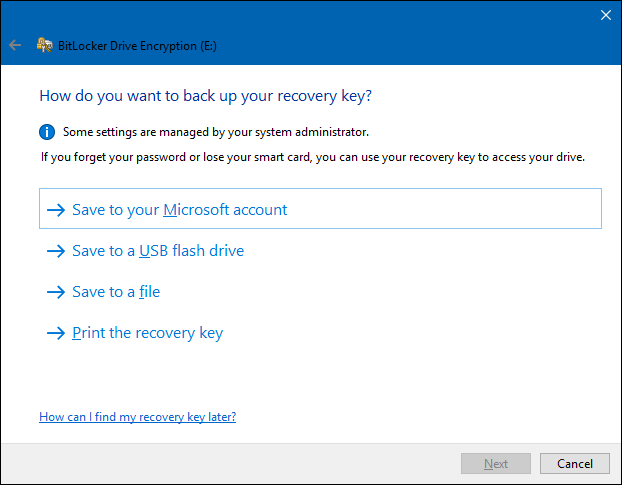
Calling that option "the default" is bit misleading when all the other options are presented with equal weight:
https://static0.howtogeekimages.com/wordpress/wp-content/upl...
Installing windows without an account being difficult is orthogonal to bitlocker saving your keys to microsoft "by default"
Microsoft explicitly calls this feature "Device Encryption", not "BitLocker", but it uses BitLocker under the hood. This happens automatically, by default. Then, if you're on Windows 11 Pro(/Enterprise/Education/... anything but Home), you have two options to secure it more:
The first and more obvious one is to add PIN/Password, but that's only adding PIN/Password protection to the existing decryption key that's already backed up to Microsoft account if you have already logged into one.
The second is to decrypt the drive and then re-encrypt it, which prompts the screen you've shown a screenshot from, where you can choose to not back the key up to your Microsoft account.
That seems... fine? You didn't enable encryption yourself, so you don't really have any expectation your data is protected. Indeed, if you didn't sign into a microsoft, your keys would be even less safe.
>The first and more obvious one is to add PIN/Password, but that's only adding PIN/Password protection to the existing decryption key that's already backed up to Microsoft account if you have already logged into one.
No, the bitlocker design avoids this by not backing up the key used for encrypting your data. Instead it encrypts that key with another key, backs up that key, and stores the ciphertext on your hard drive. This allows you to revoke such keys without reencrypting your hard drive. The same mechanism is used for passwords as well as numeric recovery keys.
If you log in to your Microsoft Account during Windows 11 setup, it will automatically create a numeric BitLocker recovery key and back it up to your Microsoft Account. This recovery key will not be revoked if you switch unlock method from TPM only to TPM+PIN. There is no GUI option to revoke this recovery key. You can only revoke it via command line.
The "Back up your recovery key" screen on the screenshot you provided only backs up the same recovery key or adds another, as evidenced by Microsoft's help article[0] claiming "You can make as many backups as you want. It's not a bad idea to have more than one, just to be safe!"
[0]: https://support.microsoft.com/en-us/windows/security/encrypt...
Note that this is meanwhile proven with both of the Bitlocker exploits that Nightmare Eclipse released this year.
And this is Apple's fault?
Except secret chats still work in the UK, for now (I think)
When you turn off ADP then you decrypt the key and give it back to Apple which it stores on its end.
Otherwise you would have to do a song and dance of re-encrypting which is expensive to do.
And if they don't, they get to keep spying on you forever....
I doubt apple let that pass design review.
The only other option is you client side re-encrypt all the data, which is not what happens today.
Per https://support.apple.com/en-gw/guide/security-pdf/sec973254... -
Conceptually, Advanced Data Protection is simple: All CloudKit Service keys that were generated on device and later uploaded to the available-after-authentication iCloud Hardware Security Modules (HSMs) in Apple data centers are deleted from those HSMs, and instead kept entirely within the Apple Account’s iCloud Keychain protection domain. They are handled like the existing end-to-end encrypted service keys, which means Apple can no longer read or access these keys.
Anyways, if Apple were doing something nefarious like retaining keys after it is turned on, we'd probably hear about it in court cases where LE would try to gain access to such keys and data.
"We pinky swear that..."
Lol
This is why we have reproducible builds. Until they do that, they could build in a "yo send the keys to the mothership" function easy peasy.
Taking this bullshit seriously is something we should stop doing. Guarantees or it doesn't count.
> not a single open source project to backup those claims
Without source code, there is no way to prove those assumptions. Saying "this is not true" is therefore a statement in bad faith.
Remember goto SSL bug? Where all Apple platforms did not even have working SSL encryption for over 15 years, unnoticed?
If you rely on hearsay and treat it as evidence, you're up for a rough awakening. That is not how NSLs work.
Possibly using corporate licensing and device management you can have your own root of trust keys implemented.
A separate paper covers security for AI cloud applications, Apple Private Cloud Compute Security Guide. [1] Their commitment to privacy there is impressive.
[0] https://support.apple.com/guide/security/welcome/web
[1] https://security.apple.com/documentation/private-cloud-compu...
> My strong impression is that the root of trust is ultimately Apple; you need to trust them.
By definition. They created the hardware design which is not publicly reviewable.
You are relying on their stated design aims and descriptions of their security architecture.
They are not having a court battle with the UK government for publicity purposes, any more than they did with the US government when the FBI demanded access.
I'm not certain of that. Heck, if Apple wanted to help an intelligence agency then the agency would tell them, 'proceed as if you didn't provide a back door'.
“many” - are keys one of the few services left out with that word?
“if” - this speaks volumes.
“most” - again, volumes. we don’t know what is left out here. Full backups, maybe?
“device-generated” - with what process? Deterministic? Which device? Even I am not paranoid enough to think the problem lies here, though, but who knows. But if you latch onto this one, it’s a red herring. The others above are enough.
Which you can't verify because all apple software is proprietary that could change at any time for specific user covertly. Apple's privacy and security does not amount to more than "trust me bro".
The near exact same deception has been put in place by Google/Microsoft/Apple with passkeys. It used to be, before passkeys, that people really could have a secret hidden behind an actual HSM, impossible to copy.
But they teamed to come up with passkeys that can now... Be copied from device to device. A secret, safe behind a HSM, replaced by something that can be copied.
What a win for security.
And all the idiots are cheering: "buuut buuuuuut buuuuuut it is CONVENIENT".
Yeah.
They're also clear that much of iCloud isn't E2EE unless you have "Advanced Data Protection": https://support.apple.com/en-us/102651
Also people dig into iOS pretty regularly and it seems very, very unlikely zero security researchers would have noticed that it's a KEK. When you use an ordinary DEK you have to run decrypt(data, key). When you have a KEK you do decrypt(data, decrypt(wrapped key, kek)). Those aren't the same code.
They used to say Privacy is a Fundamental Human right. They have since toned down of this usage a lot.
Apple cleverly wording their marketing to make it seem like they're better than they are? That never happens
England's a rather old country, and doesn't actually have any kind of constitutional mechanism that protects citizens' rights against the government. There is a bill of rights, but there's no court with the power to strike down laws that violate it, so it's essentially toothless. More modern countries tend to have supreme courts with the power to strike down rights-violating laws, e.g. the US, Japan, Germany and India.
And anyway, free speech isn't possible in a system keeping secrets. The corruption of any organization, including government, begins with its secrets. A truly free well organized people keep no secrets nor tolerate it of their governance.
We speak of democracy; what form of democracy is operating behind that secret wall? The 5-eyes conundrum is a reality - there's a superstate which exists beyond all common public knowledge about things, and which operates to give itself reasons to exist.
If there is a use for AI, its to replace all systems of secrecy, which is anathema to the creation of a model in the first place.
Citizens of all nations, not just the 5-eyes encumbered pseudo-democracies, need to demand the universality of human rights be affirmed by all who wish to rule.
On the whole I prefer the British approach here. If you want abortion to be legal, pass a law making it legal, rather than trying to conduct a courtroom seance with some oldentimes dudes. It's to the discredit of the US system that important issues such as affirmative action, gay marriage, abortion, etc. cannot (in practice) be decided by legislation at the federal level, but instead must be decided by a series of court decisions which by this point are really just a parody of legal reasoning.
This is hyperbolic. Negative news stories about the UK just get a lot of coverage at the moment. Check out some of the things that people are getting arrested for in France and Spain, for example.
The legal situation with phone passwords and the Fifth Amendment in the US is somewhat ambiguous at the moment. Americans have in fact been jailed in some instances for failing to hand over passwords after being ordered to do so.
Yes we do.
I think we have traditionally tolerated having fewer explicit protections as a society because our governments and the agencies working for them mostly haven't done lots of crazy stuff that some other "developed" countries have done. For example it's theoretically possible under our system for our Parliament to abolish elections and vote itself into power indefinitely but in reality we have elections every few years and they always result in a reasonably smooth and civilised transfer of power to whoever wins.
If that ever stopped happening then I imagine our relaxed approach might change rather quickly. We're not above a bit of civil disobedience as a society either. I doubt we would be above escalating to much more serious responses if someone really did try to seize power undemocratically. But it's been a very long time since anyone actually tried anything like that so for now it is difficult to get principled protections incorporated into law when pragmatically most normal people don't see the need for them and have much bigger things to worry about.
Of course that does not fix the problem that in more extreme or controversial cases our relatively relaxed culture does allow a real danger of government overreach and injustice and some people probably do become victims in terrible ways in some of those cases.
[1] https://en.wikipedia.org/wiki/2022_California_Proposition_1
By the way, I acknowledge that there are also advantages to the US system. I'm not really trying to argue that one system is overall better than the other. I just think it's a little unfair to suggest, as logicchains did, that the principle of parliamentary sovereignty is an outdated relic. I see it rather as the frank acknowledgement of a practical reality. You could view the current British system as old fashioned and lacking in proper constitutional protections. Or, you could view the American enthusiasm for ancient documents that magically guarantee fundamental freedoms as a phase that the British already went through (and got over) in the 16th and 17th centuries (https://www.loc.gov/exhibits/magna-carta-muse-and-mentor/int...).
The current constitution is an unwritten common law constitution, but its main point is that parliament can do whatever it wants, and as such no parliament can bind a future parliament.
They tried making it so that calling an early election needed a 70% majority in the fixed term parliament act, but when the government of the day wanted to call an early election they simply repealed it instead.
The closest we've come is the human rights act, which works around this by saying that as far as possible all future legislation should be interpreted as to comply with it, but parliament can simply override it by explicitly stating so in legislation, or repealing it.
That is to say, there is no real problem here. The UK population, or Parliament itself, could just decide to create a constitution that binds future decisions, in violation of the old constituion, and the courts would anyway not be able to stop this.
Of course, the same would be true in the future - if a future Parliament/massive part of the UK population really wanted to do something that this proposed Constitution doesn't allow, they would just change the Constitution, or abolish it, or whatever they want. Any constitution is ultimately just a piece of paper, and can be ignored.
"Our Constitution is a remarkable, beautiful gift. But it's really just a piece of parchment. It has no power on its own. We, the people, give it power. We, the people, give it meaning — with our participation, and with the choices that we make and the alliances that we forge."
And this is true for any government debts as well. Nothing can obligate a future government and the future population to pay off the debts of the old. Anybody lending money to a government should know this and expect to never be repaid. But people in general have a little harder to swallow this than constitutional changes.
So parliament can't do whatever it wants.
Apparently British parliament can't protect its citizens from being stripped of their rights by a future parliament. That's not a feature, that's a bug.
Of course this is probably a dream unless we end up in some nightmare scenario where we need to build a new government from scratch anyway. You would need exceptional legal minds to even write such a Constitution and then you would need exceptional campaigning to get it passed by a popular referendum to give it moral legitimacy - and the only political groups with the resources to do those things probably have very strong vested interests in maintaining the status quo.
The UK mechanism is elections.
The US mechanism is elections followed by waiting 50 years for the stacked Supreme Court to turn over.
This knowledge is muddled by the custom and practice of the UK government to gaslight the world, by describing the UK as a free and open society and also condemning other countries for censorship and human rights violations.
Hence you get a form of doublethink in the UK, where it is true that there is no free speech but also true that there is free speech.
Now, I don't give a shit about that conflict, but the precedent this sets is terrifying.
As for surveillance, yeah you're right the UK loves that shit. The government is always desperate to introduce laws to collect data but doesn't seem to know what to do with it
At least that's the incident usually cited on HN in support of the idea that UK is a totalitarian state.
(e) Whoever, through the use of the mail, telephone, telegraph, or other instrument of interstate or foreign commerce, or in or affecting interstate or foreign commerce, willfully makes any threat, or maliciously conveys false information knowing the same to be false, concerning an attempt or alleged attempt being made, or to be made, to kill, injure, or intimidate any individual or unlawfully to damage or destroy any building, vehicle, or other real or personal property by means of fire or an explosive shall be imprisoned for not more than 10 years or fined under this title, or both.
As I remember it, a few years ago Pine had the cheapest Linux phones even though they're not very good.
This is about cloud data access not device local access. Does graphene provide cloud data services?
I assume that people who have "something to hide" are already all running their own infrastructure, so this seems like a mass surveillance exercise more than anything.
Source?
But I think what you're implying is that after an upgrade Apple can remote into your phone as root. Do you have any evidence for this? Or can I just write you off as a tinfoil hatter.
And I am not moving the goalposts, you are being deliberately obtuse: OP said remote root access -- the operative word being access, as in they can access your phone at any time with root. So again: does Apple have remote root access to your phone? As in, can they, at any time, access my phone with root access? Does, as you say, a software upgrade, grant them such power?
The difference matters because it changes how easily they could target someone. Just handing out different pubkeys seems like it would be easier to execute and harder to detect than pushing a malicious update.
Blackberry
Cough
But I guess most people don't deserve freedom and basic rights after all. And it is not so much better than being in Russia, China or North Korea.
And that's just what we know about. The Patriot Act is carte-blache for even worse abuses, but us Americans are too obsessed with partisan freedumb to put up an honest fight.
(I think it's an even worse choice if advertising services companies, like Apple, are the "threat model")
This is of course assuming users have choice
I certainly don't choose Apple
But in reality it happens constantly that some significant piece of information comes out after being kept from the public for decades... These are just those which eventually came out. You can only imagine what information hasn't come out because those in power didn't allow it.
And what is “it” here anyway? The right to snoop on people’s private messages? That’s absolutely not the law everywhere.
So I’ve been hacking on an open source iCloud alternative built on the ATProto Spaces Alpha. It uses Apple’s FileProvider API so data from your Personal Data Server shows up as a normal folder in Finder. Still very early in development but wanted to share mostly to get folks thinking about the possibilities:
Apple won it's market thanks to its software. Sure it has nice hardware, but it is the software and especially cloud that gives them and companies like them (Microsoft, Google, Amazon) power.
The only reason why they have been crushed by open source is that people don't find certain kinds of programming fun enough to do it in their spare time (guis etc). As a result there are some usability deficiencies in open source which stop "normal people" from using it en masse.
AI solves that problem. Their days are numbered.
I had to read that a few times, but I think you intended to say they haven't been crushed by open source.
But you're really wrong about this:
Give AI few years. No one will use this bloated proprietary crap that is full of security holes for anything.
The main reason I use Apple products is because they put time effort and money into accessibility tools. Windows and Linux are complete arse when it comes to this.
Interesting. I heard people praise Microsoft in the past for accessibility.
I think the same mechanism I mentioned in my post (UI programming work not being "fun") is also responsible for the accessibility shortcomings.
I think what we desperately need are some sort of standardisation accepted by everyone. So when people use AI for creating user interfaces accessibility is one of the main considerations.
I'd have more respect for Apple if they had ignored the order and forced the UK government's hand to arrest Apple's management.
Comments are loaded live from Hacker News and are not stored by Mid or Real.